
Dizziness and Your Vision: Could BVD Be Involved?
Dizziness can be difficult to describe. You may feel lightheaded, unsteady, disoriented, as though the room is moving, or simply “off.” Symptoms may appear while walking through a busy store, scrolling on a screen, driving, reading, or shifting focus between near and far objects. Because dizziness has many possible causes—including inner-ear, neurological, cardiovascular, and medication-related issues—it should not be self-diagnosed. But when symptoms are connected to visually demanding tasks, the way your eyes work together may deserve a closer look.
Below, our Cypress eye care team at Eyes on Cypress discusses the role of vision in keeping your balance, how vision issues can cause headaches and dizziness, and what we can do to help.

How Vision Helps You Stay Balanced
Your brain combines information from your eyes, inner ears, and body to understand where you are in space. Vision provides important information about motion, depth, and stability. When the two eyes are not coordinating efficiently, the brain may have to work harder to create one clear, comfortable picture.
Binocular Vision Dysfunction (BVD), also called a Binocular Vision Disorder, describes problems with eye alignment, teaming, or coordination. The difference can be subtle. A person may still read 20/20 and have healthy eyes, yet experience discomfort because the visual system is constantly compensating. That extra effort may contribute to dizziness, motion sensitivity, eye strain, headaches, nausea, blurred or double vision, fatigue, or a feeling of being off balance.

Signs Dizziness May Have a Visual Component
A binocular vision evaluation may be worth considering if dizziness:
-
Gets worse with reading, computer work, phone use, or scrolling
-
Appears in grocery stores, crowds, traffic, or other visually busy settings
-
Occurs with headaches, eye strain, neck tension, or difficulty focusing
-
Began or became worse after a concussion or head injury
-
Continues even though a routine eye exam or other testing was described as normal
These patterns do not prove BVD, but they provide useful clues for an eye doctor who evaluates functional and binocular vision. If dizziness is new, persistent, recurrent, or unexplained, contact your healthcare professional; a binocular vision evaluation may be one part of a broader workup.
Why a Routine Eye Exam May Not Tell the Whole Story
A standard eye exam is essential for checking visual clarity, prescription, and eye health. However, a person can have clear eyesight and still struggle with eye teaming. Specialized testing looks more closely at how the eyes align, focus, track, and work together during everyday visual tasks.
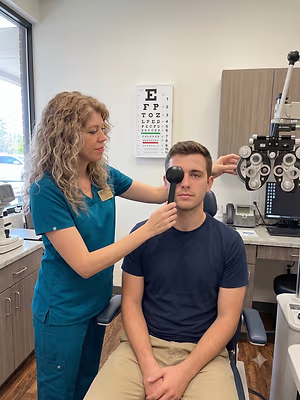
At Eyes on Cypress, our optometrists begin by listening to when your dizziness happens, what makes it worse, and what other symptoms occur. Your evaluation may include visual acuity and eye health testing along with measurements of alignment, focusing, tracking, depth perception, and binocular coordination. The goal is not to assume your eyes are the cause. It is to determine whether vision is contributing and identify the appropriate next step.

What Happens After the Evaluation?
Recommendations depend on the findings. Some patients may benefit from an updated prescription, customized prism lenses such as Neurolens®, or vision therapy. Others may need referral or co-management with a primary care doctor, ENT, neurologist, vestibular therapist, or another healthcare professional. Dizziness can have more than one contributing factor, so coordinated care may be appropriate.
Know When Dizziness Needs Urgent Care
Call 911 or seek emergency medical care for new, severe dizziness accompanied by a sudden severe headache or chest pain, weakness or numbness, trouble speaking, fainting, difficulty walking, trouble breathing, new double vision, a sudden hearing change, or ongoing vomiting. Do not wait for an eye appointment in those situations.

Schedule a Binocular Vision Evaluation in Cypress, TX
If recurring dizziness is affecting your work, driving, reading, or confidence in busy places, a binocular vision evaluation can help clarify whether your visual system is part of the problem. Schedule an appointment with Eyes on Cypress to take a closer look at how your eyes and brain work together—and what may help you feel more stable and comfortable.